



How Event Management Creates Opportunities Across Industries
More Than Just Events
When most people hear the term event management, they often think of concerts, weddings, or stage shows. While these are certainly a part of the industry, the reality is much larger than that.
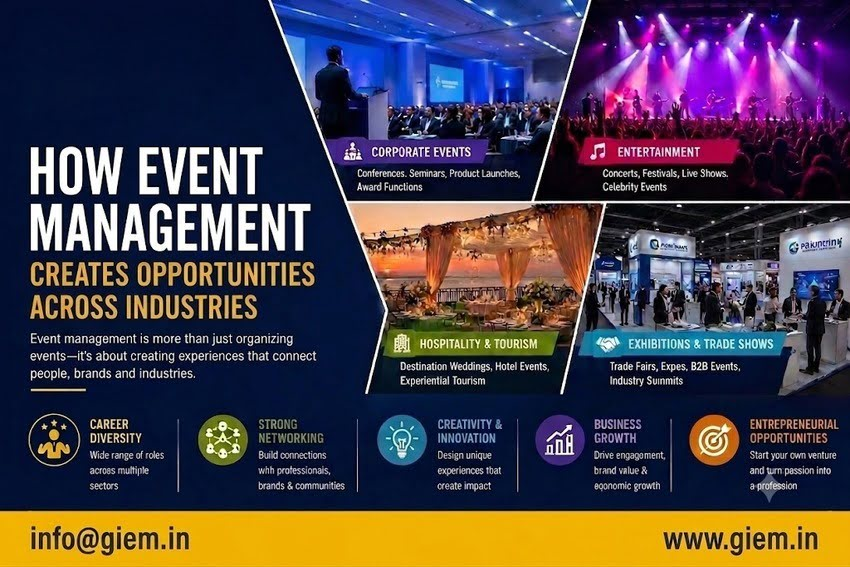
Event management today operates across multiple sectors and industries, becoming an essential part of how organisations communicate, engage, market, celebrate, and build experiences. From government summits and corporate conferences to fashion weeks, sports tournaments, exhibitions, product launches, cultural festivals, and hospitality experiences, events have become deeply connected to almost every industry around us.
This is exactly why students today are increasingly exploring Event Management Courses in Bhubaneswar that offer exposure to multiple industries instead of limiting them to traditional event roles.
The Rise of Experience-Driven Industries
Over the years, industries have shifted from simply selling products and services to creating experiences around them. Brands today want people to remember how something felt, not just what was offered.
A product launch is now designed like a full-scale experience. Corporate events are planned to reflect brand identity and culture. Fashion shows become storytelling platforms. Sports events are built around audience engagement. Even educational institutions and government organisations are increasingly using events to connect with people more effectively.
This shift has naturally increased the demand for event professionals who understand how to manage people, spaces, audiences, and experiences in real time. Opportunities Beyond One Industry
One of the biggest strengths of event management is its versatility.
A professional in this field is not restricted to one type of work or one sector alone. Someone working in corporate events today could move into entertainment, hospitality, exhibitions, sports, luxury events, destination weddings, media activations, or public events tomorrow.
The skills developed through event management remain relevant across industries because the work itself revolves around communication, execution, coordination, creativity, and problem-solving. These are skills every industry values.
This flexibility allows individuals to explore different spaces and gradually discover where they connect most naturally.
A Profession Built on Real-World Skills
Event management develops a unique combination of abilities that extend far beyond event execution itself.
Professionals learn how to work under pressure, handle large teams, manage timelines, coordinate multiple departments, communicate clearly, and solve problems quickly. Over time, they also develop leadership, adaptability, and decision-making skills that become useful in almost every professional environment.
This is one of the reasons why event professionals are increasingly valued across industries. They are trained to function in fast-moving situations while maintaining clarity and structure.And in today’s work culture, that ability has become extremely important.
The Importance of Practical Exposure
Because event management is such an execution-driven field, practical exposure plays a major role in shaping professionals.
Understanding events through theory alone is not enough. Real learning happens during live execution, when students experience how events are planned, managed, and delivered in actual environments. It is through these situations that they begin understanding industry expectations, team dynamics, audience behaviour, and the realities of working under pressure.
This exposure helps students build confidence much earlier and allows them to step into professional spaces with a clearer understanding of how industries function.
How GIEM Prepares Students for Multiple Industries
At the Global Institute of Event Management (GIEM), this evolving nature of the industry is deeply understood.
The focus is not only on teaching event management academically, but on preparing students for the diverse opportunities connected to the field. Through live event exposure, practical involvement, guest lectures, industry interaction, and hybrid learning approaches, students begin understanding how event management connects with different industries in real time.
Students are introduced to professional environments where they can observe execution closely and understand how large-scale events function across sectors. This helps them identify their strengths and gradually understand which areas of the industry align most naturally with their interests and abilities.
At the same time, the emphasis on practical learning ensures that students do not enter the industry feeling disconnected from reality. They develop familiarity with timelines, coordination, communication, and execution while they are still learning.
A Career with Expanding Possibilities
The future of event management is no longer confined to traditional events alone. As industries continue to invest in experiences, audience engagement, and live interaction, the demand for skilled event professionals will continue to grow.
What makes this field especially relevant today is the range of opportunities it creates. It allows individuals to work across industries, explore different professional spaces, and build careers that are dynamic, visible, and constantly evolving.
For students exploring Event Management Courses After 12th, the industry offers far more than a single career path. It creates opportunities across entertainment, hospitality, corporate events, sports, fashion, media, and experiential marketing.
Conclusion
Event management today is not just an industry in itself. It is a field that connects multiple industries together through experiences, communication, and execution.
As businesses, organisations, and brands continue to invest in creating meaningful engagement, the role of event professionals will only become more important.
At GIEM, the aim is to prepare students for this growing landscape through practical exposure, industry understanding, and real-world learning. Because the future of event management is no longer about managing events alone. It is about creating opportunities across industries.